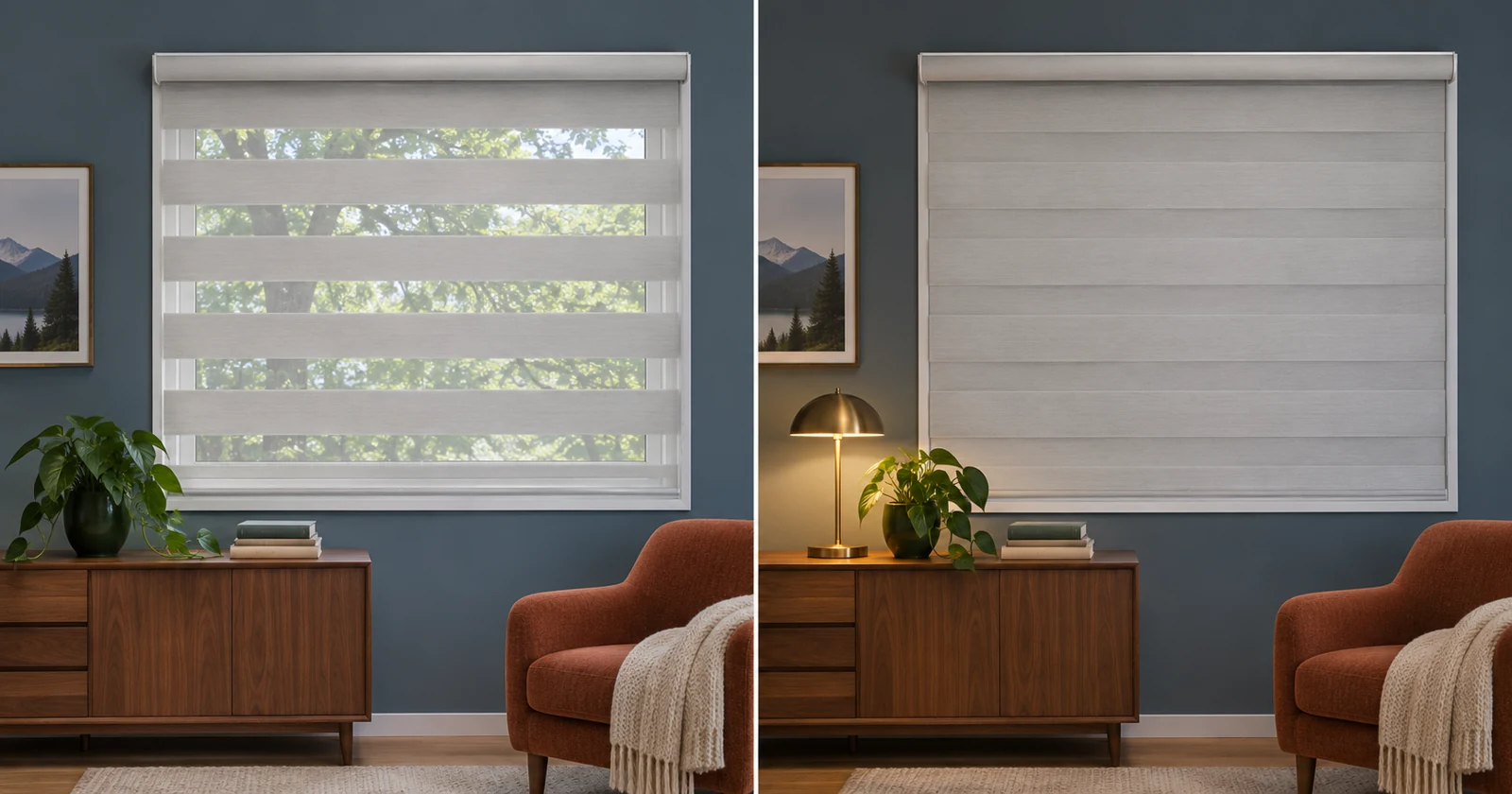
Alternating blinds use two layers of sheer and solid fabric bands to change the balance between daylight, view and privacy. Align the sheer bands to let light through, then shift the solid bands into overlap when you want more privacy. The important choice is how the fabric and band positions work in your room, especially when your needs change from day to evening.
If you are considering alternating blinds in Ottawa, Randall’s Hunter Douglas Designer Banded Shades are the relevant collection to explore. Their adjustable bands offer a different experience from a plain fabric roller shade. Here is how to decide whether that flexibility suits your windows.
How Do Alternating Blinds Work?
The fabric has horizontal sheer sections alternating with solid sections. As the two layers shift relative to each other, the bands line up in different ways.
When the sheer sections align, daylight passes through and you retain a view through those areas. When the solid bands overlap, they cover the sheer openings and increase privacy while reducing light. You can adjust the alignment as the room’s needs change.
This is different from simply raising a shade to uncover the window. Banded shades let you change the light-filtering arrangement while the covering remains across it. The visible horizontal pattern is also part of their appearance, so look at the shade in more than one position before deciding on a fabric.
Choosing Daytime Light Without Giving Up Control
Start with what happens in the room during an ordinary day. A living room used for reading, watching television and entertaining may need several settings. A home office may need softer light at the desk while still feeling connected to the outdoors.
A Living Room With a Street-Facing Window
Imagine a living room where you enjoy the daylight but do not want the window completely uncovered. Sheer-band alignment gives you a way to admit filtered light and keep a view. If privacy becomes more important, shift towards solid overlap and compare the result.
At the consultation, explain which matters most: seeing outside, softening the light or screening the room. Those are related goals, but they are not identical. Randall’s living room window treatments provide other options to compare if one priority outweighs the others.
A Home Office With Changing Light
For a workspace, describe where the window sits in relation to your screen and where you usually sit. Compare the band positions from the chair you actually use, rather than judging only from directly in front of the window.
Randall’s banded-shade page identifies home offices as a suitable application for adjustable light control. Its home office window treatments page is a useful next step if you also want to compare other ways of managing light around a desk. The aim is a comfortable working arrangement, not a promise that one shade setting will suit every screen and window.
What Should You Check for Nighttime Privacy?
For privacy, start with the solid bands fully overlapping. Randall’s describes this position as providing significant privacy. That does not mean every fabric, window and viewing angle will give the same result.
Do not base the decision only on how the shade looks in a bright showroom. Explain that you want privacy with the room lights on after dark, and ask how the proposed fabric and configuration address that situation.
If you can assess an operating example in comparable conditions, look for three things:
- Whether sheer openings remain visible in the position you intend to use.
- Whether the chosen fabric provides the screening you expect.
- Whether gaps around the covering affect the part of the room you want screened.
For example, a window beside a sofa and a window beside a dressing area have different practical priorities. Tell the consultant what needs screening and from which direction. Treat the result as a choice to verify for that window, rather than assuming that a product label guarantees complete privacy everywhere.
Privacy and Blackout Are Different Decisions
Privacy concerns what can be seen through or around a covering. Blackout concerns how much light enters the room. A shade that gives you useful privacy is not automatically the right choice when your priority is a very dark bedroom.
Randall’s Designer Banded Shades page notes that light can still enter around the edges and recommends considering room-darkening cellular or roller shades when darkness is the priority. If that is your main requirement, compare the company’s room-darkening and blackout solutions before selecting a banded fabric.
This distinction is particularly useful when choosing window treatments for several rooms at once. You may want adjustable daylight in the living room and a different light-control approach in the bedroom. There is no need to make every window use the same construction to arrive at a considered plan.
Banded Shades, Roller Shades or Sheer Shadings?
Choose banded shades when the shifting horizontal bands and adjustable view are central to what you want. They offer a strong visual pattern as well as changing light control.
Compare Designer Roller Shades if you prefer a continuous fabric surface. Their fabric options include different light-control levels, so the material selection becomes an important part of the decision.
Consider sheer window shadings if you prefer the appearance of fabric vanes with sheer layers. These are a different construction from alternating fabric bands. The guide to sheer shades explains those collections in more detail.
You do not need to choose from names alone. Seeing the treatments operate helps you compare the pattern, view and privacy positions that you will use every day.
See the Options in Your Own Space
Randall’s offers a free in-home consultation with samples, window measurement and recommendations based on your rooms, with no obligation to purchase. Bring up both daytime light and evening privacy so neither gets left out of the discussion.
Find Your Balance of Light and Privacy
To explore alternating blinds for your Ottawa home, contact Randall’s or call (613) 714-4906. Describe the rooms, the view you want to keep and when privacy matters most, and the team can help you compare suitable options.
Book Your Free Consultation